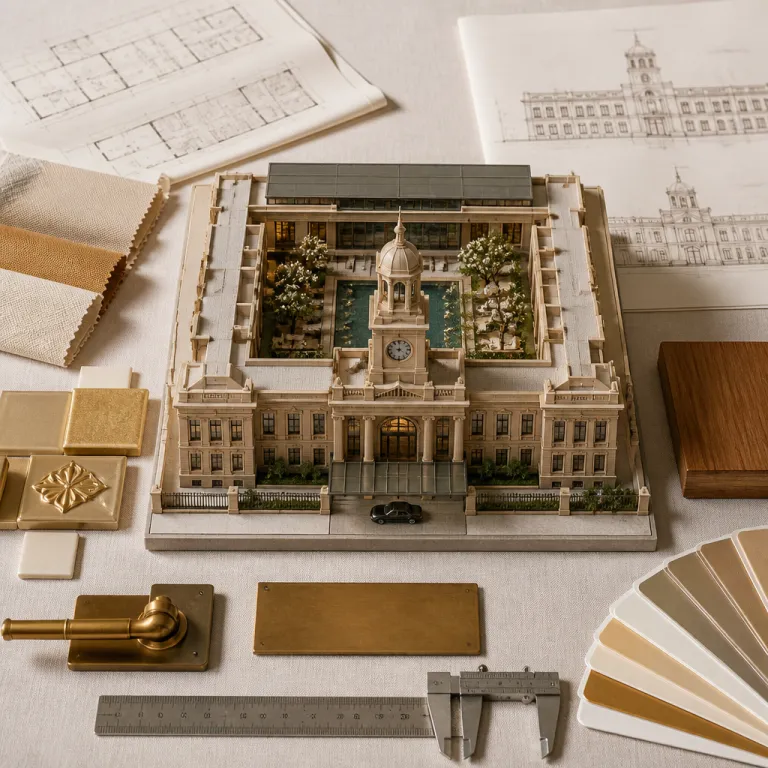
The customs house on the Chao Phraya: where Bangkok’s river trade began
Stand on the east bank of the Chao Phraya River and the old Customs House still commands the water. This low-rise neoclassical building on Charoen Krung Road once processed every major shipment that entered Bangkok, acting as the fiscal gatehouse between Siam, Hong Kong, China and the wider trading world. For luxury travelers tracking the future Langham Custom House Bangkok, understanding this riverfront past is essential.
When the Customs House opened, steamers from the United States, Europe and Asia lined up along the Chao Phraya, paying duties before cargo moved inland. The structure’s arcaded façade and symmetrical wings were designed less as a warehouse and more as a statement of state power, a building that signaled Bangkok’s arrival as a regional port. That same sense of ceremony will soon frame arrivals for guests of the future Langham Hotels project on this historic site.
The Customs House anchored what is now the Bang Rak district, long before glass towers and luxury hotels reshaped the skyline. Around it grew consulates, trading houses and early hotels and riverfront resorts that catered to merchants shuttling between Hong Kong, Shanghai and China’s treaty ports. Today, as Langham Hospitality Group and its development partners prepare the Langham Custom House transformation, they inherit not just a riverfront plot but the symbolic front door of Bangkok’s maritime era.
From revenue office to riverfront retreat: how Langham will reshape the custom house
The project now known as Langham Custom House Bangkok is an exercise in adaptive reuse at a rare scale. According to Langham Hospitality Group’s official announcement and Rabbit Holdings Public Company Limited disclosures, approximately 6 billion baht has been earmarked to turn the Customs House and its neighbours into a tightly edited luxury ensemble, rather than a sprawling mega-resort.[1][2] That investment signals confidence that discerning guests will pay for history, not just for another tall hotel.
The plan divides the site into three distinct but connected components that together form a new Langham Hotels flagship in Asia. The restored Customs House becomes the ceremonial heart, the former post office building is reimagined for amenities, and a contemporary tower rises behind them to hold around 78 guest rooms, as confirmed in Langham’s project Q&A.[1] For travelers used to anonymous hotel resorts along the river, this layered composition will feel more like a curated residence than a conventional tower.
For business-leisure guests who treat Bangkok as a second base between Hong Kong and the United States, the project’s scale is part of the appeal. A 78-room tower means the Langham Custom House experience can stay intimate, with staff quickly learning preferences and patterns. If you want to understand how this fits into the city’s broader premium landscape, look at how the Luxus Collection is redefining premium hotel booking experiences in Bangkok and you will see why a focused, heritage-led property resonates.
Designing between centuries: balancing heritage architecture and contemporary luxury
Restoring the Customs House for Langham Custom House Bangkok is not a cosmetic exercise. Architects are working from historical blueprints and on-site surveys to stabilise the original masonry, then layering in modern construction techniques that can quietly support twenty-first-century hospitality. The challenge is to keep the building reading as a nineteenth-century customs house while it functions as a contemporary luxury hotel.
Inside, the Langham Hospitality design brief focuses on generous volumes rather than maximal room counts, which is why the main guest accommodation shifts to the new tower. That contemporary building will carry the mechanical load, allowing the Customs House to host public spaces, signature dining and perhaps a few statement suites without overburdening its structure. For guests, this means you will sip a drink beneath original beams while your room benefits from the latest acoustic insulation and climate control next door.
The former post office building on the site becomes the connective tissue between old and new, housing spa facilities, a patisserie and other amenities that support both the heritage wing and the tower. Travelers planning peak-season stays should track the project timeline alongside broader strategies for booking Bangkok’s peak season hotels, because the opening phase will be heavily waitlisted. When the doors finally open, the Langham Custom House vision will show how a customs house, a post office and a new tower can operate as one coherent hospitality-group property.
Location, location, river: why Bang Rak’s heritage corridor matters
The future Langham Custom House Bangkok sits in one of the city’s most walkable luxury corridors. Step out from the Customs House and you are on Charoen Krung Road, in the heart of the Bang Rak district that has quietly become Bangkok’s design spine. This is where restored shophouses, riverside hotels and contemporary galleries share the same soi as family noodle stalls.
Directly across the Chao Phraya, ICONSIAM pulls in brands from Hong Kong, China and the United States, turning this stretch of river into a retail and dining axis. Yet the real charm lies on the Customs House side, where you can wander from the future Langham Hotels entrance to creative warehouses, small cafés and long-running gold shops within minutes. For a deeper read on how Charoen Krung to Bang Rak is evolving as a luxury hotel corridor, explore this detailed walking guide to tracing Bangkok’s most walkable luxury hotel corridor.
From a booking perspective, this location gives you both river and city without compromise, which is rare even among top-tier hotel resorts in Asia. Long-stay guests can commute easily to Sathorn or Silom business towers, then return to an address that feels rooted in history rather than in a mall. Night owls will appreciate that the river piers, creative bars and old-school banquet-style Chinese dining rooms are all within a short walk or boat hop from the Customs House steps.
Culinary ambitions: from Hong Kong’s T’ang Court to Charoen Krung
One of the most anticipated elements of Langham Custom House Bangkok is culinary. Langham Hospitality Group is bringing T’ang Court, its three-Michelin-star Cantonese restaurant from The Langham, Hong Kong, directly into the Customs House complex.[1] That move instantly positions the property as a serious dining address, not just another riverfront hotel with a view.
This is where the China Langham and China Cordis experience in Greater China pays dividends for Bangkok diners, because the group has spent decades refining high-end Cantonese service. When T’ang Court opens here, you can expect a dining room that respects the Customs House proportions while introducing contemporary lighting, art and table spacing that match global luxury standards. For business travelers, hosting clients in a restaurant with a Hong Kong pedigree inside a restored Thai customs building will be a powerful gesture.
Beyond T’ang Court, the hospitality group is expected to program the former post office building with a patisserie, bar and possibly a river-facing brasserie that leverage the Langham Hotels brand. The idea is that you will move through a sequence of spaces during the day, from coffee beneath high ceilings to cocktails at the river’s edge, without ever leaving the Customs House compound. That layered experience is what separates this project from more generic hotel resorts that rely solely on rooftop bars and buffet breakfasts.
How the Custom House project fits into Bangkok’s heritage hotel landscape
Bangkok has seen a wave of adaptive reuse projects, but Langham Custom House Bangkok occupies a different category. Many heritage conversions in the city work with former schools, banks or family mansions, while this one reimagines a customs house that once mediated trade between Bangkok, Hong Kong, China and the United States. That commercial past gives the building a cosmopolitan DNA that aligns naturally with the Langham Hospitality ethos.
Compared with other riverside hotels, the scale here is deliberately restrained, with around 78 rooms rather than several hundred.[1] That allows the hospitality group and Rabbit Holdings to focus on service depth, training a tight équipe that can deliver the kind of anticipatory gestures business-leisure travelers expect from top-tier hotel resorts in Asia. It also means the property can function as a true city house, where repeat guests are recognised by name rather than by room number.
The project also signals how international brands like Langham Hotels and Cordis can collaborate with local partners to protect heritage while still achieving commercial results. As the official project Q&A notes, “Built in 1888, it served as the main customs office.” and “When will The Langham, Custom House, Bangkok open? Scheduled for late 2026.” and “Who is leading the hotel’s development? Langham Hospitality Group and Rabbit Holdings.”[1] For travelers choosing between new-build towers and heritage-driven properties, those statements underline why this particular Customs House, on this particular stretch of the Chao Phraya, will matter.
Key figures behind the Custom House transformation
- The restoration and development budget is approximately 6 billion Thai baht, a level of investment that places Langham Custom House Bangkok among the most capital-intensive heritage hotel projects in the city, according to reporting by The Finest Thai and DotWNews and supported by Rabbit Holdings filings.[2][3]
- The contemporary tower is planned to hold around 78 guest rooms, a relatively low key count compared with many Bangkok riverfront hotels that often exceed 250 rooms, which supports a more personalised service model.[1]
- The Customs House stands on Charoen Krung Road in the Bang Rak district at roughly 13.7235° N and 100.5146° E, positioning the future hotel within a short walk of both creative warehouses and major river piers.
- The development timeline runs across several years, with restoration work beginning earlier in the decade and the opening targeted for late 2026, which means early adopters should plan bookings well in advance of that date.[1]
- The project brings together Langham Hospitality Group, Rabbit Holdings Public Company Limited and local artisans, illustrating how international hospitality brands and Thai partners can jointly revitalise a landmark Customs House.
FAQ about Langham Custom House Bangkok
What is the historical role of Bangkok’s Custom House?
Bangkok’s Customs House on the Chao Phraya River was built as the main customs office that controlled and taxed goods entering the capital by water. For decades, ships from Hong Kong, China, the United States and Europe stopped here to clear cargo before moving upriver. That function made the building a central node in Bangkok’s emergence as a regional trading hub.
When will The Langham, Custom House, Bangkok open to guests?
The official project timeline points to a late 2026 opening for The Langham, Custom House, Bangkok.[1] Restoration and construction work are being phased to stabilise the heritage structure, rework the former post office and complete the new tower. Travelers interested in staying during the first season should monitor booking channels and consider waitlists once reservations go live.
Who is developing Langham Custom House Bangkok?
The project is led by Langham Hospitality Group in partnership with Rabbit Holdings Public Company Limited, an affiliate of the BTS Group. Langham brings its experience from properties such as The Langham, Hong Kong and its Cordis hotels in Asia, while Rabbit Holdings contributes local development expertise. Together they are overseeing the transformation of the Customs House, the adjacent building and the new tower.
How many rooms will the hotel have and what is the scale?
The contemporary tower at Langham Custom House Bangkok is planned to offer around 78 guest rooms, which is modest compared with many riverfront hotels in the city.[1] This relatively low room count supports a more intimate, house-like atmosphere and allows the hospitality group to focus on high-touch service. Guests can expect a quieter, more residential feel than in larger convention-oriented properties.
How does the location benefit business and leisure travelers?
The Customs House site sits on Charoen Krung Road in the Bang Rak district, directly opposite ICONSIAM across the Chao Phraya. Business travelers gain quick access to Sathorn and Silom, while leisure guests can walk to creative spaces, markets and river piers within minutes. That combination of connectivity and heritage character makes the address particularly attractive for travelers extending work trips into short riverfront breaks.
Trusted references for further reading
- Langham Hospitality Group official site and project announcements for The Langham, Custom House, Bangkok, including the project Q&A and press releases outlining the late-2026 opening, room count and concept.[1]
- Rabbit Holdings Public Company Limited disclosures on joint development projects in the Bang Rak district and filings related to the Customs House redevelopment.[2]
- DotWNews and The Finest Thai coverage of heritage hotel investments and the Customs House restoration budget, which provide additional context on capital commitments and design direction.[3]
Author: Compiled from Langham Hospitality Group and Rabbit Holdings project materials, supplemented by reporting from The Finest Thai and DotWNews.